The Complete Guide to Floating Docks on the Chesapeake Bay
If you own waterfront property on the Chesapeake Bay or its tributaries, you have probably spent some time thinking about dock options. Fixed piling docks have been the standard for decades, but floating docks have gained serious ground — and for good reason. They handle tidal swings, adapt to changing water levels, and in many cases cost less to install than their fixed counterparts.
We have been building docks across Virginia's Northern Neck and Middle Peninsula for over 24 years. In that time, we have seen floating dock technology evolve from basic foam-filled platforms into sophisticated modular systems that rival any fixed structure. This guide covers everything you need to know before making a decision.
What Is a Floating Dock?
A floating dock is exactly what it sounds like: a dock platform that sits on the water's surface and rises and falls with the water level. Instead of being mounted on pilings driven into the bottom, a floating dock relies on buoyancy — typically from sealed air chambers, foam billets, or molded polyethylene pontoons — to stay at the waterline.
The dock is held in position by an anchoring system, which can range from simple chain-and-anchor setups to guided piling sleeves that allow vertical movement while preventing lateral drift.
The key advantage is simple: your dock is always at the same height relative to the water. Your boat, your gear, and your feet stay at a consistent, comfortable level no matter what the tide or weather is doing.
How Floating Docks Work
Every floating dock system has three core components:
Buoyancy. The platform needs to displace enough water to support its own weight plus the load you put on it — people, furniture, boats, equipment. Commercial-grade floating docks use enclosed air chambers or high-density polyethylene floats that will not absorb water over time. Cheaper options use EPS foam blocks, which can degrade, absorb water, and lose buoyancy after a few years.
Decking. The walking surface can be composite, pressure-treated wood, aluminum, or in the case of modular systems like CanDock, the buoyancy and decking are integrated into a single molded cube. The decking material matters for longevity, traction, heat, and maintenance.
Anchoring. The dock must stay where you put it. Anchoring methods vary based on water depth, bottom conditions, and exposure to wind and current. We will cover anchoring in detail below.
Types of Floating Docks
Traditional Floating Docks
These are built as large platform sections — typically wood or aluminum frames with foam billets underneath. They look and feel similar to a fixed dock but float. Sections are usually 8 to 12 feet long, bolted together, and connected to shore with a hinged gangway or ramp.
Traditional floating docks work well, but they have drawbacks. The foam billets can degrade. The frames require periodic maintenance. And because the sections are large and heavy, reconfiguring or expanding the dock later is a significant project.
Modular Floating Docks
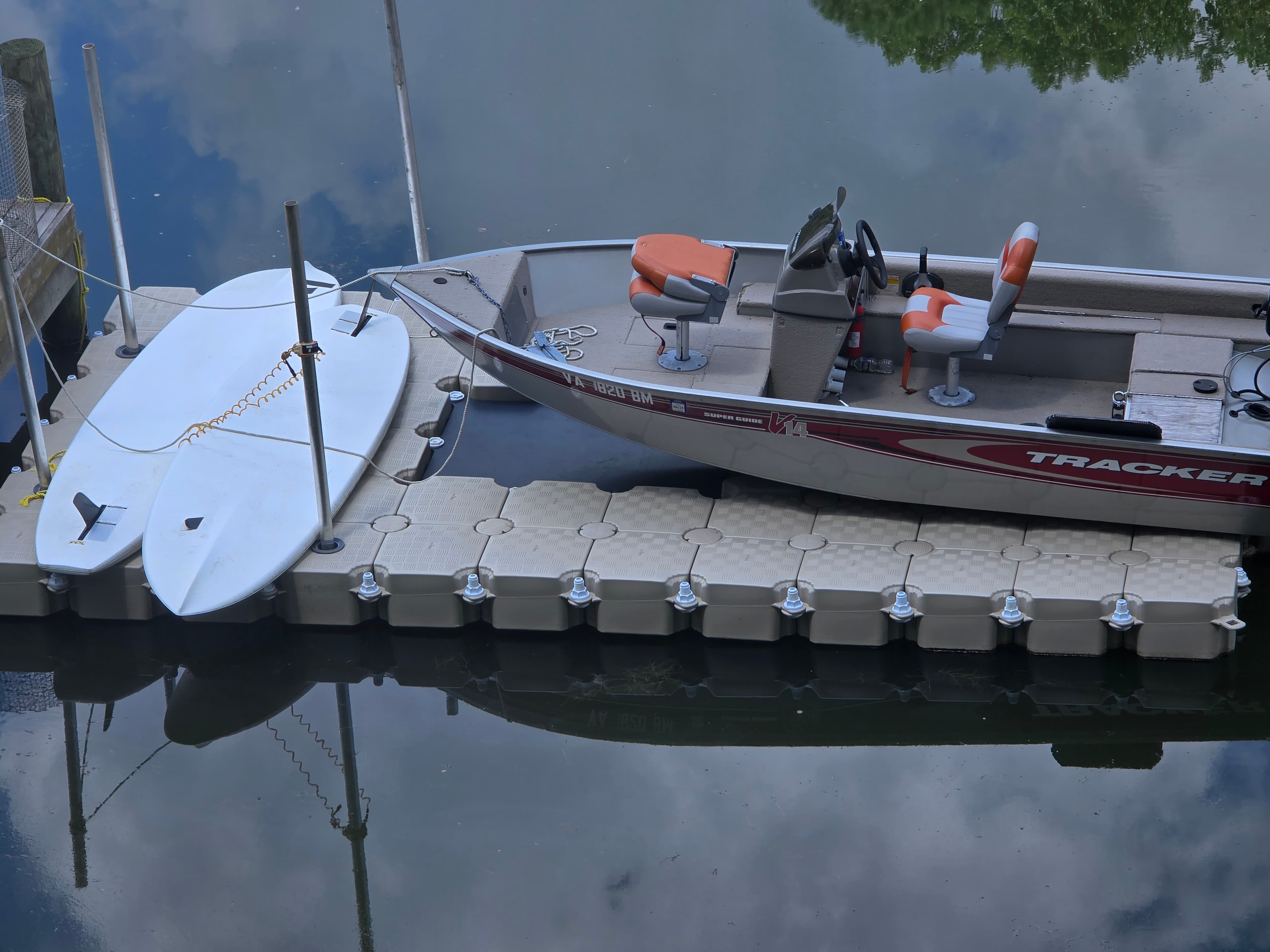
Modular systems take a different approach. Instead of large pre-built sections, they use interlocking individual cubes or blocks — typically two to four feet square — that snap or pin together to form any shape you need. Want an L-shape? A T-shape? A full marina with slips? You build it like assembling blocks.
The modular approach gives you flexibility that traditional floating docks simply cannot match. You can start with a basic walkway and add a PWC platform next season. You can reconfigure the layout if you buy a bigger boat. And if a section gets damaged, you replace individual cubes instead of an entire platform.
CanDock: The Premium Modular System
Not all modular docks are created equal, and this is where we need to talk about CanDock. CanDock is a Canadian-engineered modular floating dock system made from UV-stabilized, rotationally molded high-density polyethylene. Each cube is a single sealed unit — the buoyancy and the deck surface are one piece, with no foam to degrade, no frame to corrode, and no separate decking to replace.
CanDock cubes connect with a heavy-duty pin system that allows slight flex between sections, which helps the dock absorb wave energy instead of fighting it. The surface texture provides excellent traction even when wet, and the material stays cool enough to walk on barefoot in summer — something anyone who has stepped on a dark composite dock in July will appreciate.
Docks of the Bay is the only authorized CanDock dealer in the state of Virginia. We have installed these systems on the Rappahannock, the Piankatank, Dividing Creek, and throughout the Chesapeake Bay region. We handle the design, permitting, and installation so you get a turnkey result.
Floating Dock vs Fixed Dock: Which Is Right for You?
This is the question we get asked most often. Here is an honest comparison.
Where Floating Docks Win
Tidal areas. The Chesapeake Bay sees tidal swings of one to two feet on a normal day, and storm surges can push water levels much higher — or pull them much lower. A fixed dock is built at one height. If the water drops, you are climbing down to your boat. If it rises, your dock may be underwater. A floating dock eliminates this problem entirely.
Shallow or variable-depth water. If your shoreline is shallow or the bottom drops off unpredictably, pilings can be difficult and expensive to install correctly. Floating docks need enough water to float (typically 18 to 24 inches minimum) but do not care about what the bottom looks like 10 feet down.
Permitting. In many Virginia localities, floating docks face fewer permitting hurdles than fixed structures. Because they do not involve driving pilings into the bottom, the environmental impact assessment is often simpler. This is not universal — always check with your county and the Virginia Marine Resources Commission (VMRC) — but it is a real advantage in many cases.
Flexibility. Moving, expanding, or reconfiguring a floating dock is straightforward compared to a fixed dock. If you sell your property, a modular floating dock can even go with you.
Where Fixed Docks Win
Heavy loads and large vessels. If you are docking a 40-foot sportfisher or need a dock that supports a boat lift rated for 15,000 pounds, a fixed piling dock is likely the better choice. Fixed docks can handle heavier concentrated loads because the pilings transfer weight directly to the bottom.
High-energy environments. Properties that face open fetch across miles of bay water deal with significant wave action. Fixed docks stand up to this better than most floating systems, though well-designed floating docks with proper anchoring can handle more than people expect.
Permanence and tradition. Some waterfront owners simply prefer the look and feel of a traditional piling dock with a covered boat lift. That is a perfectly valid preference, and we build those too.
The Hybrid Approach
Many of our clients end up with a combination: a fixed dock and walkway with a floating platform at the end for PWC access, swimming, or small boat docking. This gives you the structural strength of pilings where you need it and the water-level convenience of a floating section where it matters most.
Why Floating Docks Make Sense on the Chesapeake Bay
The Chesapeake Bay presents a specific set of conditions that floating docks handle exceptionally well.
Tidal fluctuations. As mentioned, normal tides swing one to two feet. But nor'easters, tropical systems, and sustained wind events can push water levels three feet or more above or below normal. During these events, fixed docks become difficult or impossible to use. Floating docks just ride it out.
Soft bottoms. Many tributaries and creeks along the Northern Neck and Middle Peninsula have soft, silty, or muddy bottoms. Driving pilings in these conditions requires longer pilings and sometimes specialized equipment, which drives up fixed dock costs. Floating docks avoid this issue.
Seasonal changes. Water levels on the Bay shift seasonally, running higher in late summer and fall, lower in winter and spring. A floating dock stays at the optimal boarding height year-round.
Storm resilience. A well-anchored modular floating dock can actually be partially disassembled and moved to a protected area ahead of a major storm. Try doing that with a fixed dock.
Anchoring Methods for Floating Docks
The anchoring system is arguably the most important part of any floating dock installation. A beautiful dock that drifts into the channel is not doing anyone any good.
Piling guides (sleeves). The dock has vertical sleeves that slide up and down on fixed pilings. This is the most secure method and works well in areas with moderate water depth. The dock moves vertically with the water level but cannot shift laterally.
Chain and anchor. Heavy anchors on the bottom with chains running to the dock corners. This is common in deeper water where pilings are impractical. The dock has some lateral movement (a "watch circle"), which must be accounted for in the layout.
Shoreline connection with spud poles. The dock attaches to shore via a hinged ramp, and spud poles (vertical poles that penetrate the bottom through brackets on the dock) prevent lateral movement on the water end. This works well in relatively calm, protected waters.
Bottom-anchored cables. Helical anchors or deadweight anchors on the bottom with cables running to the dock. Similar to chain-and-anchor but with less lateral movement.
The right anchoring method depends on your water depth, bottom type, exposure, and local regulations. This is one of the areas where experience matters — we have anchored docks in everything from two feet of water over hard sand to eight feet over soft mud, and the approach is different every time.
Floating Dock Cost: What to Expect
Floating dock cost varies widely based on size, materials, configuration, and site conditions. Here are general ranges for the Virginia market as of 2026:
Traditional floating docks: $30 to $60 per square foot for the dock structure, plus anchoring, gangway, and installation. A typical 6-by-20-foot floating dock section with a ramp and piling anchors might run $8,000 to $15,000 installed.
Modular floating docks (CanDock): $40 to $75 per square foot depending on configuration and accessories. A basic 6-by-24-foot walkway with a PWC platform might run $12,000 to $22,000 installed. Drive-on PWC docks start around $4,000 to $6,000 for the dock section alone.
Accessories and add-ons: Kayak launches, swim platforms, bumpers, cleats, ladders, and custom configurations all add to the total. One of the advantages of CanDock is that you can add these over time rather than committing to everything up front.
These are ballpark figures. Every waterfront property is different, and the only way to get an accurate number is a site visit. Contact us for a free consultation and estimate.
Real-World Floating Dock Scenarios
PWC platforms. Personal watercraft are hugely popular on the Bay, and a drive-on floating dock is the easiest way to launch, load, and store a jet ski. CanDock makes dedicated drive-on configurations that let you idle your PWC directly onto the dock — no lift, no trailer, no hassle. The PWC sits out of the water, which reduces hull fouling and corrosion.
Swim platforms. A floating swim platform anchored 30 or 40 feet off your shoreline gives you a deep-water swimming and sunbathing spot without a long fixed dock. Add a ladder, some deck padding, and you have a private swim club.
Boat docking. Floating finger piers and slips keep your boat at a consistent height relative to the dock, making boarding safer and easier — especially for families with children or older adults. No more climbing up or down three feet depending on the tide.
Kayak and paddleboard launches. Low-profile floating dock sections with built-in launch channels make it easy to get on and off paddle craft without kneeling in mud or wading through oyster shells.
Permitting Considerations in Virginia
Any dock construction on Virginia waterways requires permits. For floating docks, you will typically need:
- A VMRC permit (Virginia Marine Resources Commission) for any structure on state-owned bottomlands
- A local wetlands board or county permit depending on your jurisdiction
- In some cases, a U.S. Army Corps of Engineers permit for larger installations
Floating docks sometimes qualify for a VMRC General Permit rather than an individual permit, which can significantly speed up the approval process. The specifics depend on the size of the dock, the waterway classification, and whether the project involves any bottom disturbance.
We handle permitting as part of our full-service dock construction process. After 24 years of building on these waters, we know the requirements for every county in the Northern Neck and Middle Peninsula, and we have working relationships with the relevant agencies.
Making Your Decision
A floating dock is not the right answer for every waterfront property, but it is the right answer for more of them than most people realize — especially here on the Chesapeake Bay where tidal changes and soft bottoms are facts of life.
If you are considering a floating dock, here is what we recommend:
- Start with a site assessment. Water depth, bottom conditions, exposure, and your intended use all drive the design. We do these at no cost.
- Think about what you need now and what you might want later. If expansion is likely, a modular system like CanDock gives you that flexibility without wasting your initial investment.
- Do not skimp on anchoring. The dock is only as good as what holds it in place.
- Work with a licensed contractor. Dock construction in Virginia requires a Class A contractor's license. We have held ours for over two decades.
Ready to talk about a floating dock for your property? Get in touch with our team for a free site visit and estimate. You can also browse our CanDock product line to see the modular options available.
Docks of the Bay has been building on the Chesapeake Bay and its tributaries for over 24 years. We are a licensed Class A contractor and Virginia's only authorized CanDock dealer. Whether you need a simple swim platform or a full marina layout, we have the experience to get it done right.
Ready to Start Your Project?
Contact us for a free consultation and estimate on your marine construction project.
Get a Free Estimate