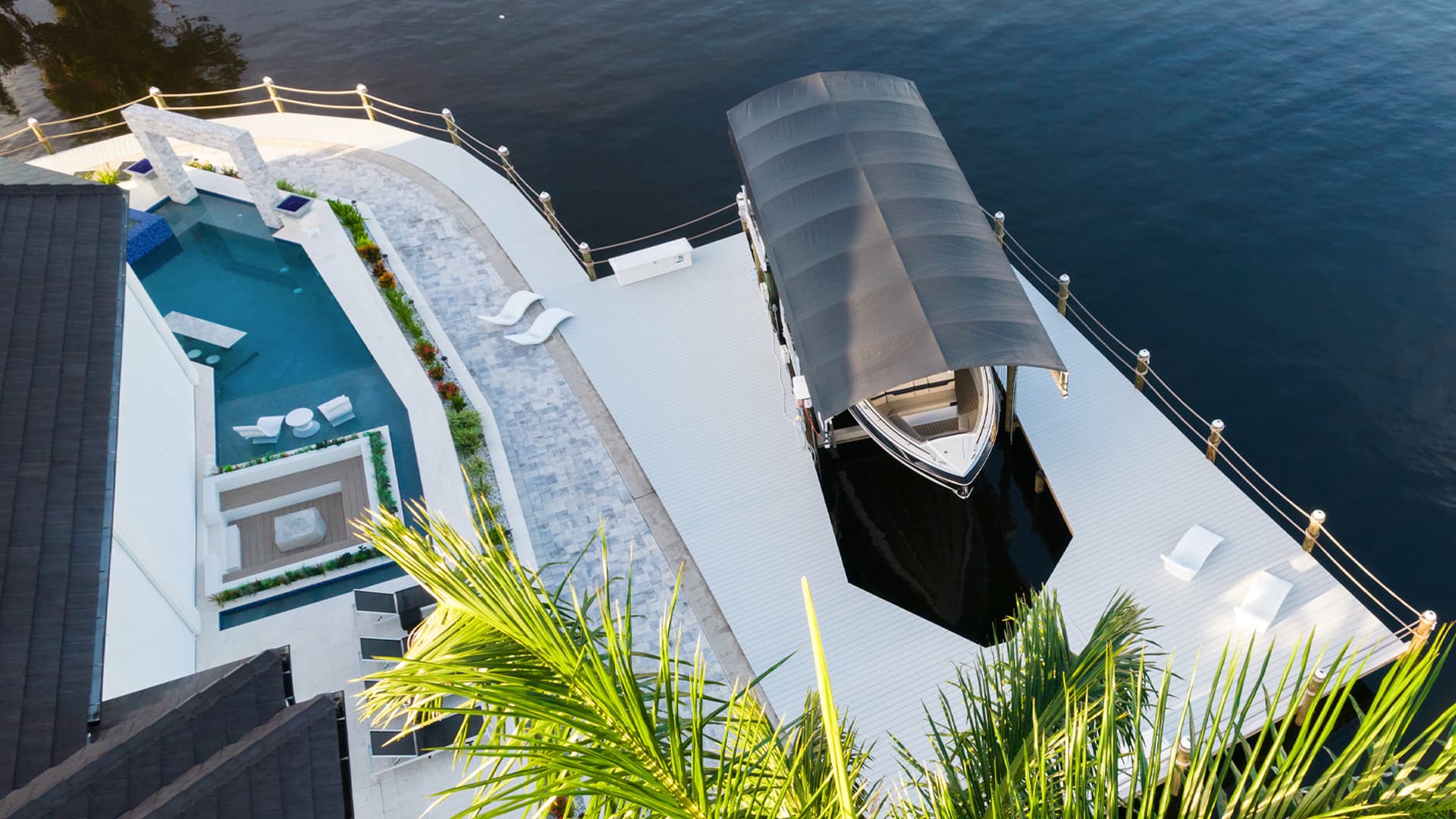
WearDeck vs. Trex: Which Dock Decking Is Better for Saltwater?
If you are shopping for composite dock decking, you have probably come across both WearDeck and Trex. They look similar on the surface -- synthetic boards that promise low maintenance and long life. But when it comes to building a dock on the Chesapeake Bay, the similarities end quickly.
After 24 years of marine construction on Virginia's Northern Neck, we have installed just about every decking product on the market. We have watched some of them hold up beautifully for decades, and we have watched others fail within a few seasons over saltwater. That experience is what shapes our recommendation: for docks, piers, and boathouses, WearDeck is the better choice.
That does not mean Trex is a bad product. It is excellent for what it was designed for. The distinction matters, and understanding it will save you money and headaches down the road.
What WearDeck Is Made Of
WearDeck is a solid PVC (polyvinyl chloride) dock board. There is no wood fiber in it -- not a single particle. It is extruded from 100% synthetic PVC polymer with marine-grade UV stabilizers blended throughout the material.
This matters because PVC is inherently waterproof. It does not absorb moisture at the molecular level. Water sits on the surface and drains away. Salt crystals rinse off. The board itself is the same material all the way through, so even if you scratch or gouge it, you are not exposing a vulnerable core.
WearDeck was designed from the ground up for one purpose: marine decking. Docks, piers, marinas, boathouses, fish cleaning stations, waterfront boardwalks. Every engineering decision in the product reflects that mission.
What Trex Is Made Of
Trex is a wood-plastic composite (WPC). It combines recycled wood fibers with recycled polyethylene plastic, wrapped in a protective polymer shell (on their higher-end lines like Transcend and Enhance). The shell protects the wood-fiber core from surface moisture and staining.
Trex is the most recognized name in residential decking for good reason. It transformed the backyard deck market and their product performs well in that application. But the key phrase is "residential decking." Trex was engineered for attached decks, porches, and patios -- structures on solid ground with normal drainage and airflow.
The Core Difference: Marine vs. Residential
Here is the fundamental issue. A dock is not a deck.
Your backyard deck sits on land. It gets rained on, dries out, and sees occasional standing water. A dock sits directly over water -- sometimes partially submerged during storms and high tides. It is constantly exposed to humidity, salt spray, tidal splash, and sustained UV radiation reflected off the water surface. The underside of dock boards rarely dries completely.
A product engineered for a patio simply faces different conditions than a product engineered for a pier. That engineering gap shows up in warranty coverage, material performance, and long-term durability.
Head-to-Head Comparison
Here is how WearDeck and Trex stack up across the factors that matter most for dock construction:
| Feature | WearDeck | Trex (Transcend) | |---|---|---| | Material | Solid PVC (no wood fiber) | Wood-plastic composite (WPC) | | Moisture Absorption | Near zero -- PVC does not absorb water | Wood fibers in core can absorb moisture over time | | Marine Warranty | 25-year limited warranty, valid over water | Residential warranty; typically excludes or limits coverage over water | | Heat Retention | Stays cooler underfoot; lighter colors reflect heat | Gets notably hot in direct sun, especially darker colors | | UV Stabilization | Marine-grade UV stabilizers throughout | UV-resistant cap layer on surface | | Mold/Mildew | No organic material to feed mold growth | Wood fibers can support mold if cap is compromised | | Slip Resistance | Textured surface, good wet traction | Textured surface, adequate wet traction | | Color Options | Multiple colors including dock-appropriate tones (Harbor Grey, Sand, Coastal Cedar) | Wide residential color palette | | Weight | Heavier per board (solid PVC) | Moderate weight | | Cost (installed) | $12-18 per sq ft (material + labor) | $10-16 per sq ft (material + labor) | | Best Application | Docks, piers, marinas, boathouses | Residential decks, porches, patios |
Note: Installed costs vary by region, dock configuration, and access. Contact us for an accurate estimate for your project.
Why WearDeck Wins on the Water
1. Zero Moisture Absorption
This is the single biggest advantage. WearDeck boards do not contain wood fiber, so there is nothing to absorb water. Wood-plastic composites like Trex rely on a protective cap to keep moisture away from the wood-fiber core. On a residential deck, that cap does its job well. On a dock, where boards are exposed to constant humidity, salt spray, and occasional submersion, moisture can eventually work its way into the core through cut ends, fastener holes, or cap damage. Once wood fibers absorb water, you get swelling, soft spots, and accelerated degradation.
2. The Warranty Actually Covers Marine Use
WearDeck offers a 25-year limited warranty that explicitly covers marine applications -- docks, piers, and structures over water. This is not a technicality. It is a major differentiator. Most residential composite decking warranties, including Trex's, contain language that limits or excludes coverage when the product is installed over water. If your decking fails on a dock and the warranty does not cover marine use, you are paying for replacement out of pocket.
Always read the warranty documents carefully. "Limited lifetime warranty" sounds impressive until you discover it does not apply to your dock.
3. Stays Cooler Underfoot
Anyone who has walked barefoot on dark composite decking in July knows the problem. WearDeck's solid PVC construction and lighter color options result in a surface that stays noticeably cooler than wood-plastic composite in direct sunlight. On a dock where people are barefoot coming off boats, this is not a luxury -- it is a practical safety and comfort consideration.
4. No Organic Material Means No Food for Mold
Mold and mildew need organic material to feed on. WearDeck contains none. Surface mildew from airborne spores can land on any outdoor surface, but it wipes off WearDeck easily and cannot penetrate the material. With wood-plastic composites, if the protective cap is compromised -- by a scratch, a dropped anchor, or years of wear -- mold can establish itself in the wood-fiber core.
5. Purpose-Built Fastening and Installation
WearDeck is designed to work with stainless steel marine fasteners and standard dock framing. The installation details -- screw spacing, gapping for thermal expansion, ventilation underneath -- are all specified for marine structures. When we install WearDeck, we are following the manufacturer's marine installation guidelines, not adapting residential deck instructions to a dock environment.
Where Trex Makes Sense
We want to be fair. Trex is a strong product for residential applications. If you are building a deck attached to your house, a screened porch, or a patio, Trex Transcend or Enhance are solid choices. The color selection is broader, the price is competitive, and the warranty covers those installations comprehensively.
We are not saying Trex is a bad product. We are saying it was not built for the environment your dock lives in. Choosing residential-grade decking for a marine structure is like putting all-season tires on a boat trailer -- it might work for a while, but it is not what the engineers had in mind.
Other Marine-Grade Options We Install
WearDeck is our primary recommendation for PVC dock decking, but it is not the only marine-grade product we work with. Depending on your project, budget, and priorities, we also install:
LumberOck
LumberOck is another solid PVC decking board designed specifically for marine environments. It offers excellent moisture resistance and comes in several color options. Like WearDeck, it contains no wood fiber and carries a warranty that covers marine use. It is a strong alternative if you prefer its color palette or profile dimensions.
ThruFlow
ThruFlow is a unique marine decking product with a perforated design that allows water to drain directly through the board surface. This is particularly useful for areas that see regular wash-over, fish cleaning stations, or docks where standing water is a concern. The open design also reduces wind uplift forces on the decking. ThruFlow is not for every application, but where drainage is a priority, it is an excellent solution.
All three of these products share the critical trait that separates them from residential composites: they were engineered for life over water.
The Real Cost Calculation
WearDeck typically costs a bit more per square foot than Trex in material price. On a 400-square-foot dock, you might see a difference of $800-1,200 in materials. That gap narrows when you factor in marine-grade stainless fasteners (which you need regardless of decking choice) and installation labor (which is comparable).
But the real cost calculation is not about the initial price. It is about what happens in year 8, year 12, year 20. A WearDeck dock that is properly installed and maintained will look and perform nearly the same at 20 years as it did at installation. A residential composite board over saltwater may need replacement far sooner -- and replacing dock decking is not a weekend project. You are paying for crew time, barge access, removal, disposal, and reinstallation.
Over the life of a dock, WearDeck is typically the less expensive choice.
What We Recommend for Northern Neck Docks
After building docks on the Chesapeake Bay and its tributaries for over two decades, our recommendation is straightforward:
Use marine-grade PVC decking on any structure over water. WearDeck is our go-to product for most dock, pier, and boathouse projects. For specific applications where drainage is critical, we recommend ThruFlow. LumberOck is a solid alternative depending on availability and color preferences.
We do not install residential-grade composite decking on marine structures. It is not a product we feel confident warranting our labor against, and we would rather have a direct conversation about that than install something we know will underperform.
See WearDeck and Marine Decking Options
If you are planning a new dock or replacing worn decking on an existing structure, we carry WearDeck and other marine-grade decking products. You can view samples and color options at our marine supply store or browse our marine decking products online.
Want to talk about which decking product is right for your dock? We are happy to walk your site, assess your existing structure, and give you an honest recommendation. Check out our dock construction and repair services or get in touch with us directly.
Docks of the Bay is a Class A licensed marine contractor serving White Stone, Irvington, Kilmarnock, Deltaville, and communities throughout Virginia's Northern Neck and Middle Peninsula. We have been building docks on the Chesapeake Bay and its tributaries for over 24 years.
Have questions about WearDeck or dock decking options? Contact Docks of the Bay for a free consultation and estimate.
Ready to Start Your Project?
Contact us for a free consultation and estimate on your marine construction project.
Get a Free Estimate